Can the source be found?
Review canonical URLs, robots rules, sitemaps, llms.txt, rendered HTML, and the page links that define the public source.
An AI visibility audit connects your public-site structure, official facts, AI answer evidence, and engineering work. It shows what is reachable, what is extractable, what was measured, and what still needs verification.
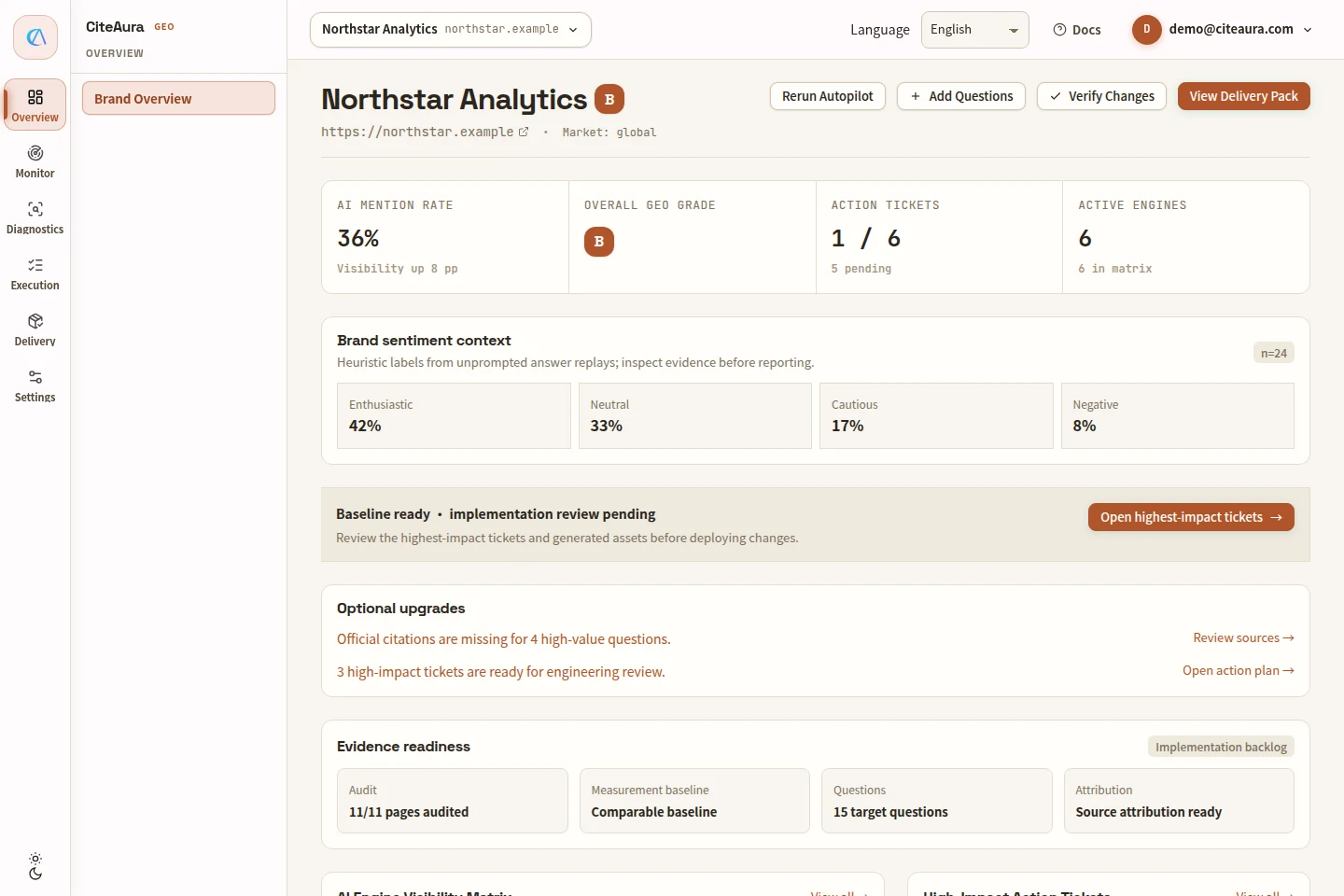
A useful audit separates the source you control from the answers you observe. That keeps a crawl problem, a missing official fact, and ordinary model variance from being collapsed into one unexplained score.
Review canonical URLs, robots rules, sitemaps, llms.txt, rendered HTML, and the page links that define the public source.
Check the product definition, pricing, structured data, official claims, and page structure that make a brand easy to identify and quote.
Use a fixed question set and provider cohort. Keep raw answers, mentions, citations, sample coverage, and sampling mode attached to the result.
Start with category, comparison, recommendation, pricing, and problem questions a real buyer could ask. Keep brand probes separate.
Record what a crawler can reach and what the initial HTML exposes before changing copy or adding generated assets.
Label API model knowledge, web-grounded retrieval, and manual product-surface observations separately. Missing coverage remains unmeasured.
Prioritize the smallest useful page, fact, schema, or crawl change with an acceptance condition that someone can verify.
Compare the same source, questions, cohort, and measurement window. A changed answer is evidence for that scope, not a universal guarantee.
| Question | Traditional SEO audit | AI visibility audit |
|---|---|---|
| Primary signal | Can search crawlers discover, understand, and index the page? | Can AI systems reach, extract, retrieve, mention, or cite the defined source? |
| Evidence | Technical checks, page content, links, and search performance data. | Technical checks plus question-level answers, citations, provider, mode, and sample coverage. |
| Output | SEO findings and recommendations for search visibility. | Evidence-backed tickets, acceptance checks, and a comparable re-sample. |
| Boundary | Does not prove how every AI product will answer. | Does not guarantee rankings, mentions, or citations outside the defined cohort and period. |
Use the CiteAura measurement methodology for cohort rules, or start with the guide to measuring ChatGPT brand mentions.
Check that the canonical product definition, buyer questions, and official facts are available before you expect AI answers to describe the offer.
Re-check redirects, page structure, machine files, structured data, and the links that keep a source identifiable.
Keep a comparable baseline for content, engineering, and growth teams instead of relying on a single answer screenshot.
It checks whether a public website exposes the pages and official facts that AI systems can reach, extract, retrieve, and cite for a defined question set.
No. Traditional SEO and AI visibility audits answer different questions. Use both when you need search traffic and evidence about how AI answers describe a brand.
Yes. Start with a public technical audit. Model sampling is a separate, explicitly labeled evidence stream that can be added later.
It proves that the defined checks passed for the recorded source and time window. It does not guarantee a future ranking, mention, or citation.