Make the source reachable
Review canonical URLs, robots rules, sitemaps, `llms.txt`, rendered HTML, and page structure before changing the message.
CiteAura connects public-site structure, official facts, AI answer evidence, and engineering work so your team can move from a vague visibility concern to a verified next step.
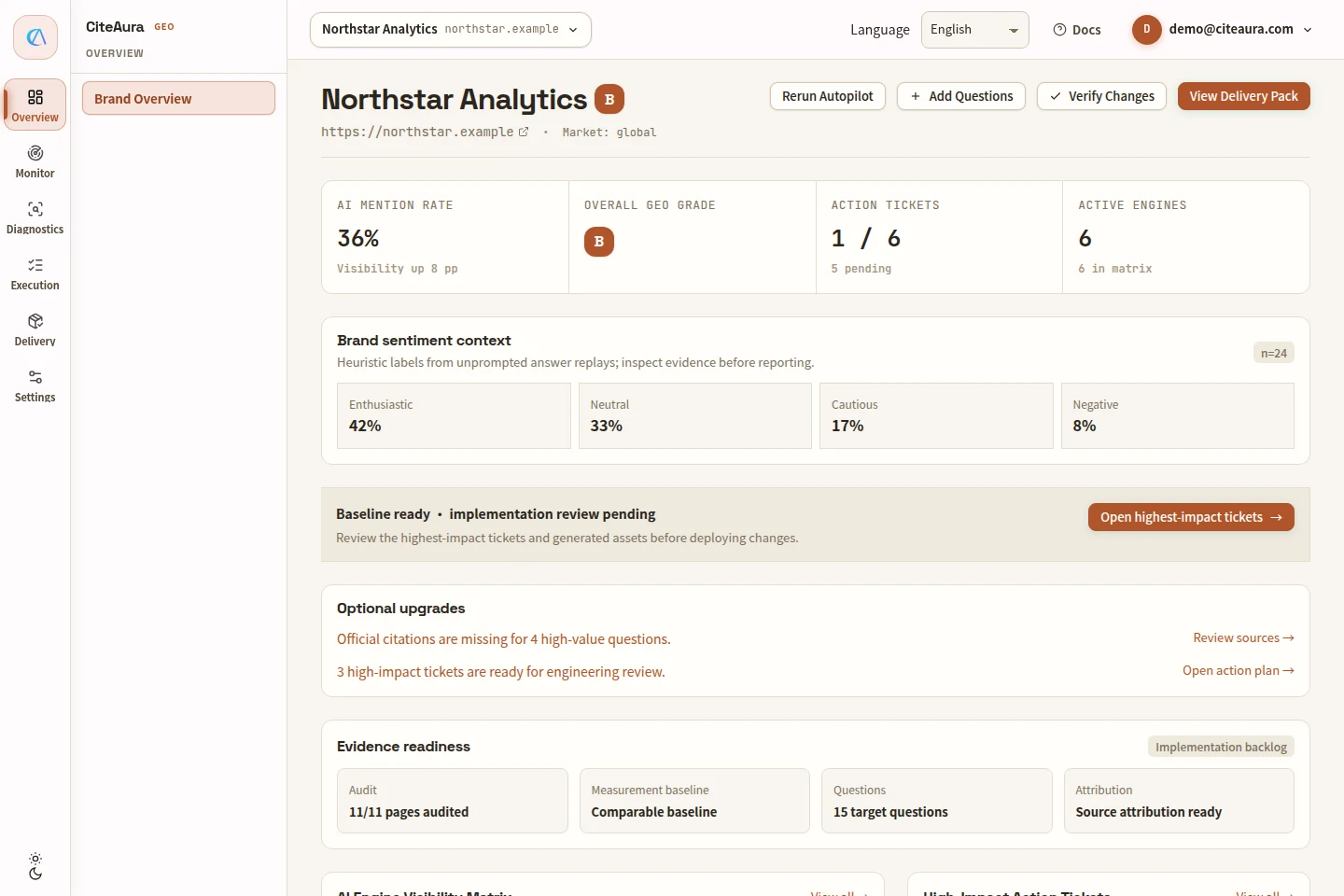
AI answers vary. A useful workflow starts by separating what your public site says, what a crawler can reach, what a provider retrieved, and what a human observed in a product interface.
Review canonical URLs, robots rules, sitemaps, `llms.txt`, rendered HTML, and page structure before changing the message.
Compare the same questions, providers, sampling mode, and time window so a new answer is not mistaken for a universal trend.
Turn the highest-impact gap into an owner-ready ticket, deploy the change, and re-crawl or re-sample against the acceptance check.
Start with a public HTTPS URL. CiteAura creates a workspace and records the initial crawl scope.
Confirm the product definition, canonical facts, competitors, and buyer-intent prompts before sampling.
Use page findings, citation gaps, and answer evidence to choose the smallest useful set of technical and content changes.
Keep the original evidence, run the acceptance checks, and expose remaining uncertainty instead of filling it with a score.
Public-site crawlability, extractable facts, structured data, citation signals, and labeled AI answers for a defined question and provider cohort.
Yes. Re-crawl the site and compare a defined before-and-after period while preserving the sampling mode and cohort.
No. The score summarizes checks in a defined scope. Provider retrieval, model updates, and answer variance remain separate evidence.